
Why Your Attention Shapes Your Entire Reality — And How to Train It

Your brain can process millions of signals every second. Yet you only ever experience a tiny slice of reality. That slice? You get to aim it.
Right now, as you read this, your brain is ignoring an enormous amount of information. The slight tension in your jaw. The ambient sounds of the room. The weight of your phone in your hand. None of it reached your awareness — because your attention was pointed here instead.
That's not a failure. That's the system working exactly as designed. Attention is the brain's filter — and what it lets through becomes, quite literally, your lived experience.
Your attention doesn't just observe your life. It constructs it.
Attention as energy
Think of attention like a battery. It's finite — it depletes, it needs recharging, and every choice you make about where to spend it comes at a cost. Without it, nothing exists in your world. No thought can form, no feeling can land, no decision can be made. It's the invisible prerequisite for everything.
But here's what makes it remarkable: unlike money or time, it bends to your will. It's trainable. A musician develops ears sharp enough to catch the space between notes. A diagnostician learns to spot what everyone else walks past. A trader becomes wired to sense the faintest market tremor. In each case, years of directed attention carved out a new kind of perception — a new slice of reality, invisible to everyone else.
What you practice noticing, you begin to see. And what you never practice, you remain blind to.
The spotlight problem
Attention works like a spotlight in a dark theater. It can only illuminate one area at a time — and whatever falls outside that circle simply doesn't exist for you in that moment. This sounds obvious. The consequences are anything but.
Point the spotlight at threats, and your world becomes full of dangers. Point it at progress, and you begin noticing opportunities you were always standing next to. Point it at other people's lives, and yours will always feel lacking. Same room. Same theater. Completely different show.
KEY IDEA
Your personality shows up most clearly in your habitual patterns of attention — what you automatically scan for, what you notice first, what you linger on. These patterns aren't fixed. But they do compound. What you attend to today shapes what you're capable of attending to tomorrow.
When the spotlight becomes a beam: flow
There are rare moments when attention stops scattering. When everything — thought, feeling, action — aligns toward a single point. No inner noise. No second-guessing. Just clear, forward motion.
Psychologists call this state flow. Athletes call it "the zone." You've almost certainly felt it, even if briefly: writing a paragraph that seemed to write itself, solving a problem where the solution just appeared, playing music where your hands moved without instruction.
In flow, psychic energy stops leaking. There's no friction between what you're doing and what you want to be doing. The challenge matches the skill — not so easy that it's boring, not so hard that it's paralyzing. Just enough tension to keep everything taut and alive.
Flow isn't reserved for athletes or artists. It shows up in any moment where full attention meets the right challenge.
Crucially: the activity doesn't have to be glamorous. Monotonous work can enter flow. Repetitive tasks can enter flow. The magic isn't in the task — it's in the orientation. Attention brought deliberately, fully, with the intent to improve.
How flow builds the self
Flow doesn't just feel good in the moment. It leaves something behind. Each time you move through it, something in you grows — and that growth happens in two directions at once:
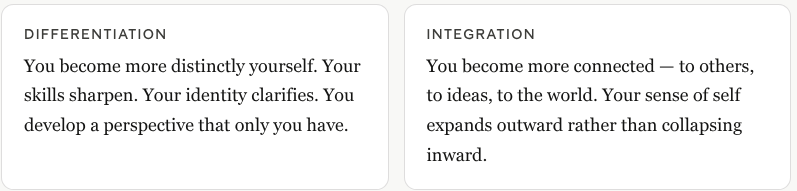
Too much differentiation without integration leads to ego — an island, self-sufficient but isolated. Too much integration without differentiation leads to shapelessness — absorbed into everything, belonging to nothing. The healthiest selves are both: deeply individual and genuinely connected.
Flow is where both happen simultaneously. You're fully absorbed in your own doing, and fully present with the world it's happening in.
The practical question
None of this requires a dramatic life change. It starts with something else: noticing where your attention actually goes, versus where you intend it to go.
Most of us have never audited this. We drift. We let notifications pull the spotlight. We let anxiety set the agenda. We outsource the steering to whoever or whatever is loudest.
But the spotlight is yours. It has always been yours. And wherever you aim it, reality tends to grow.
The question isn't how do I change my life? It's — where am I pointing my attention?
That question, asked honestly and often, is where most worthwhile things begin.
P.S. — The clip was made alongside this piece. Same thought, different form. Worth a watch.


Comments